Mon - Sat | 09:00 - 19:00


Find

Contact us

Odesa
Hrushevskoho str., 41
 Мережа СТО в місті
Місто
 +38 (096) 299 29 97
Odesa
Hrushevskoho str., 41
 Мережа СТО в місті
Місто
+38 (096) 299 29 97

 Години роботи
 Mon - Sat
09:00 - 19:00
When Should You Polish Your Car’s Paintwork?
How the Condition of Paintwork Changes Over Time
Even with careful vehicle use, the paintwork gradually loses its original appearance. The body is constantly exposed to dust, sand, road salt, UV radiation, tree branches, and minor mechanical damage. As a result, the surface becomes less glossy, the color loses its depth, and micro-scratches and haze begin to appear in the clear coat.
These changes are especially noticeable on dark-colored vehicles. After washing, circular swirl marks, fine scratches, and the so-called “spider web” effect become clearly visible in sunlight. Many drivers consider this a normal part of aging, although in many cases the appearance of the vehicle can be significantly improved without repainting.
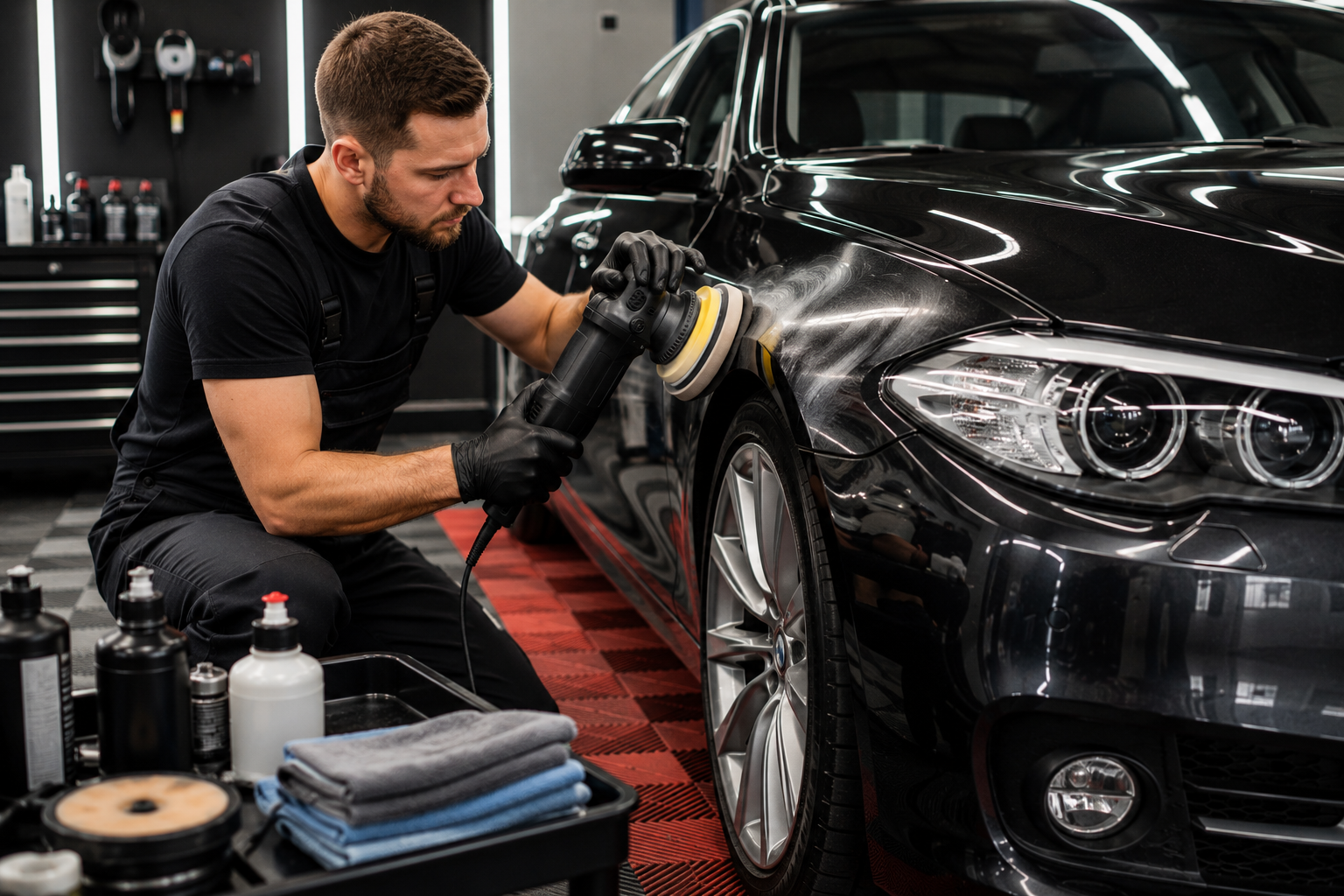
This is exactly what paint correction and body polishing are designed for. However, it is important to understand that car polishing is not a universal solution for every type of damage. The result depends directly on the depth of the defects and the overall condition of the paintwork.
What Defects Can Be Removed by Polishing?
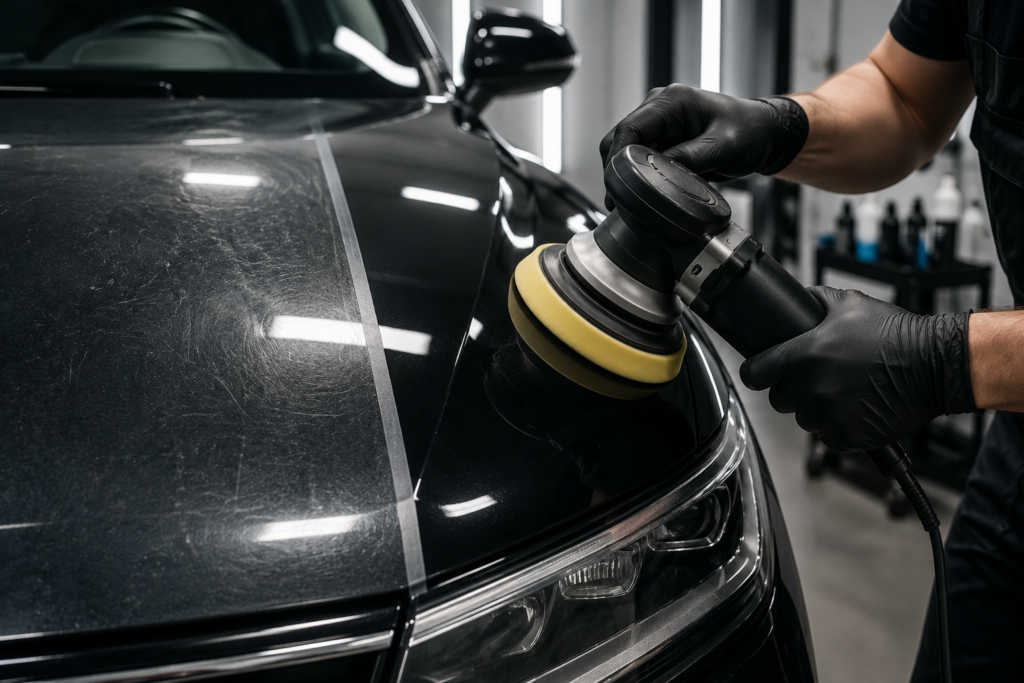
Body polishing is effective for eliminating surface imperfections located within the upper layer of the clear coat. Most commonly, these include:
- micro-scratches caused by improper washing;
- marks from automatic car wash brushes;
- light scuffs and abrasions;
- paint haze and dullness;
- oxidation marks;
- minor scratches on the bodywork;
- light marks caused by branches or clothing.
After a properly performed polishing procedure, the surface becomes smoother, the color appears deeper, and the body reflects light more effectively. The vehicle itself looks significantly fresher, even without any body repair work.
Car polishing is often performed before selling a vehicle, as even a minor restoration of the paintwork can noticeably improve its overall appearance.
Protective coatings also play an important role after polishing. The following products may be applied to the vehicle’s surface:
- wax;
- ceramic coating;
- quartz-based coatings;
- polymer protection.
These materials help preserve the results for a longer period and reduce the impact of external factors on the paintwork.
When Polishing Is No Longer Enough
Not every defect can be removed through polishing. If scratches are too deep and extend into the paint layer or reach the metal underneath, polishing may only partially conceal the damage or provide no visible improvement at all.
Polishing will not solve problems such as:
- paint chips;
- corrosion;
- cracked clear coat;
- peeling paint;
- severe mechanical damage.
In such cases, full paint restoration or localized body repair is required.
Many vehicle owners try to repeatedly polish the same area to hide defects. However, it is important to remember that abrasive polishing removes a small amount of clear coat. If performed too frequently, the paint system gradually becomes thinner and less resistant to external influences.
Special care should be taken with vehicles that have been repainted. The thickness of the clear coat can vary significantly between panels, and excessive polishing may sometimes damage the surface.
The Difference Between Light and Deep Polishing
Light polishing is used to refresh a vehicle’s appearance with minimal impact on the clear coat. It removes minor imperfections, enhances gloss, and restores visual freshness.
This type of polishing is often performed:
- before selling a vehicle;
- after winter;
- as part of a detailing service;
- before applying a protective coating.
Light polishing is suitable for vehicles with paintwork in generally good condition and without major defects.
Deep polishing is a more complex process. It involves abrasive compounds, multiple polishing stages, and different polishing pads. The main goal is to remove visible imperfections, oxidation marks, and pronounced micro-scratches.
However, it is important to understand that deep polishing always involves removing a portion of the clear coat. For this reason, it is not recommended unless truly necessary, especially on vehicles with thin paint systems.
Before polishing, it is advisable to assess the actual condition of the paintwork rather than relying solely on how the surface looks after washing.
How Often Should You Polish a Vehicle?
The frequency of polishing depends on the vehicle’s operating conditions and the level of paint care it receives. If the vehicle is regularly washed with stiff brushes or frequently driven on highways, micro-scratches tend to appear much faster.
The right time to polish a vehicle depends primarily on the condition of the surface. Common signs that the paintwork may need restoration include:
- the paint has lost color depth;
- the surface appears dull;
- circular swirl marks are visible;
- micro-scratches can be seen in sunlight;
- the vehicle looks worn even after washing.
Light polishing can be performed periodically to maintain appearance and protect the vehicle’s bodywork. Deep polishing, however, should be carried out much less frequently because of its effect on clear coat thickness.
In practice, proper maintenance after polishing is just as important as the polishing process itself. High-quality car care products, careful washing techniques, and protective coatings can help preserve the condition of the paintwork for much longer without the need for repeated polishing.
Top popular news
- There is a smell of gasoline under the hood, but there are no signs of a leak: where to look for the problem
- Volkswagen Golf 7: which engines are considered the most successful in the secondary market
- Why do errors appear after a night frost that disappear after warming up?
- The car stalls when you suddenly release the gas: what happens at this moment
- Audi A6 with 200+ thousand mileage: what expensive malfunctions can be predicted in advance
- Why does my car start to consume more oil even though my driving style hasn’t changed?
- The ABS light came on on the dashboard: can I continue driving?
- Volkswagen Passat B8 or Skoda Superb: what will the car show after 200 thousand km

Subscribe to our newsletter!
To stay updated with the latest news

Book a service