Mon - Sat | 09:00 - 19:00


Find

Contact us

Odesa
Hrushevskoho str., 41
 Мережа СТО в місті
Місто
 +38 (096) 299 29 97
Odesa
Hrushevskoho str., 41
 Мережа СТО в місті
Місто
+38 (096) 299 29 97

 Години роботи
 Mon - Sat
09:00 - 19:00
Engine Endoscopy Before Buying a Car: What Hidden Defects Can Be Detected Without Disassembling the Engine
Buying a used car always involves the risk of hidden defects. Even if the body looks well maintained, the mileage raises no suspicion, and computer diagnostics show no error codes, this still does not guarantee that the engine is in good condition. The most expensive problems are often hidden inside the engine and may remain unnoticed for a long time during everyday operation. That is why engine endoscopy has become one of the most important stages of inspecting a used vehicle before purchase.
What Is Engine Endoscopy and How Does the Technician Access the Combustion Chamber?
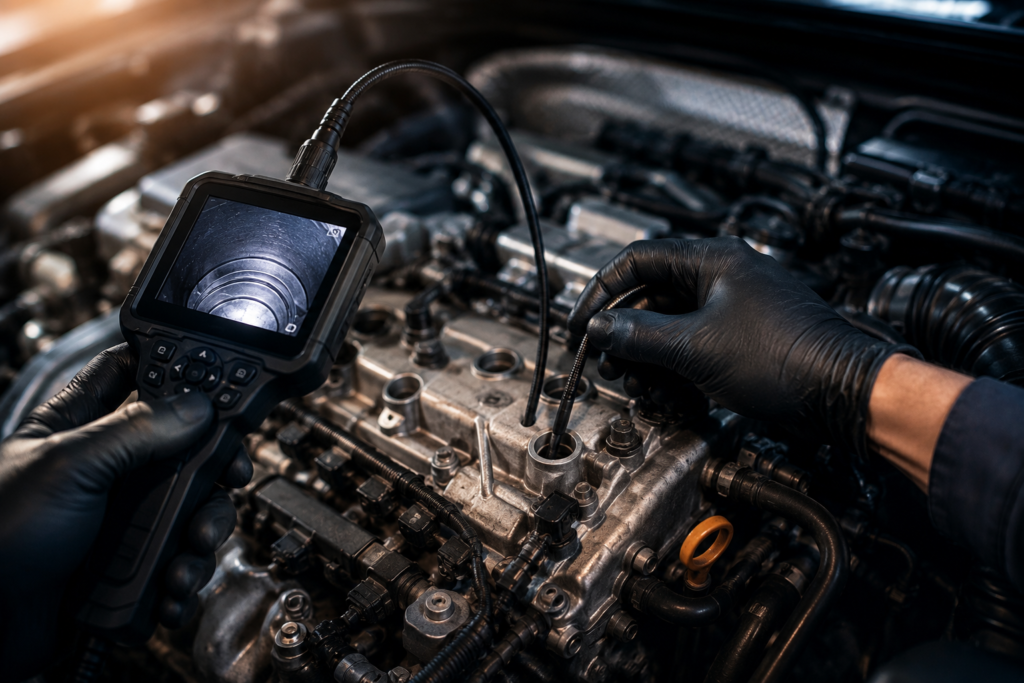
Engine endoscopy is a diagnostic method that allows technicians to assess the internal condition of the cylinders without disassembling the engine. A special technical endoscope is used for the inspection a flexible probe equipped with a miniature video camera and built-in illumination.
To gain access to the combustion chamber, the spark plugs are removed on gasoline engines. The endoscope camera is then inserted directly into the cylinder through the spark plug hole. The image is transmitted to a monitor, where the technician can carefully examine the condition of the engine’s internal surfaces.
During engine endoscopy, the technician can inspect:
- the cylinder wall (cylinder bore);
- the piston surface;
- the valves;
- the combustion chamber walls;
- the upper part of the cylinder-piston assembly.
Unlike many other inspection methods, endoscopy allows the technician to see the actual condition of engine components rather than relying solely on indirect signs of wear.
Why Computer Diagnostics Alone Are Not Enough
Many buyers limit the inspection to reading fault codes from the engine control unit, believing this is sufficient. However, computer diagnostics only evaluates the operation of the vehicle’s electronic systems and cannot determine the physical condition of the cylinders, pistons, or valves.
An engine may run smoothly, have no diagnostic trouble codes, and perform well during a test drive while already having early cylinder scoring, worn cylinder honing, or significant carbon deposits inside. Therefore, computer diagnostics and engine endoscopy do not replace one another they complement each other during a comprehensive pre-purchase inspection.
What Problems Can Engine Endoscopy Detect?
The primary purpose of the procedure is to assess the condition of the cylinder walls and identify damage that could result in costly engine repairs.
Cylinder Wall Scoring
In most cases, engine endoscopy is performed specifically to detect cylinder scoring. These are vertical scratches or grooves on the cylinder walls caused by the breakdown of the lubricating oil film between the piston and the cylinder wall.
The most common causes of cylinder scoring include:
- engine overheating;
- delayed engine oil changes;
- using engine oil that does not meet the required specifications;
- dust or abrasive particles entering through the intake system;
- engine knock (detonation);
- excessive loads on a cold engine.
When cylinder scoring develops, the combustion chamber gradually loses its sealing capability. As a result, engine compression decreases, oil consumption increases, and the likelihood of expensive engine repairs grows significantly. This is often how excessive oil consumption begins a problem well known to owners of modern turbocharged engines.
Cylinder Honing Wear and Cylinder Wall Condition
During the inspection, the technician also evaluates the condition of the cylinder honing. Honing is the fine crosshatch pattern of microscopic grooves on the cylinder walls that retains the lubricating oil film between moving components.
If the honing pattern is severely worn or barely visible, it may indicate high mileage, poor maintenance, or prolonged engine operation under heavy loads. Loss of the honing pattern accelerates wear of the cylinder-piston assembly and reduces the overall service life of the engine.
Cracks and Mechanical Damage
Engine endoscopy also makes it possible to detect localized cracks, chips, and other mechanical defects on the piston surface or inside the combustion chamber. Such damage may result from overheating, detonation, low-quality fuel, or prolonged operation of the engine with existing mechanical issues.
Burnt Valves
Particular attention is paid to the condition of the valves. Signs of valve burning or deformation may indicate improper combustion and prolonged engine operation at excessively high temperatures.
A burnt valve causes the combustion chamber to lose its seal, resulting in reduced compression and poor engine performance.
Excessive Carbon Deposits on the Pistons
The condition of the pistons also provides valuable information about how the vehicle has been operated. A small amount of carbon buildup is considered normal for an engine with mileage. However, heavy carbon deposits often indicate hidden problems.
Based on the appearance of the deposits, an experienced technician can identify indirect signs of:
- excessive engine oil consumption;
- fuel system problems;
- engine overheating;
- improper combustion of the air-fuel mixture;
- the early stages of excessive oil consumption.
For this reason, carbon deposits are evaluated not only by their amount but also by their structure and color.
Why Engine Endoscopy Is Especially Important for TSI and TFSI Engines
Among owners of VAG Group vehicles, TFSI engine endoscopy has long become a standard procedure before purchasing a used car. It is particularly relevant for EA888 family engines, which were installed in numerous Volkswagen, Audi, Skoda, and SEAT models.
Modern TSI and TFSI engines deliver high specific output and operate under significant thermal and mechanical loads. They are highly sensitive to engine oil quality, adherence to maintenance intervals, and operating conditions. Even minor deviations in servicing can accelerate wear of the cylinder-piston assembly.
In practice, there are many cases where a vehicle successfully passes computer diagnostics and shows no obvious signs of engine problems, yet engine endoscopy reveals localized cylinder scoring, worn cylinder honing, or excessive carbon buildup inside the combustion chamber. That is why, for VAG turbocharged engines, engine endoscopy is considered one of the most important stages of a pre-purchase inspection.
How Much Money Can Engine Endoscopy Save Before Buying a Car?
The search query “engine cylinder endoscopy price” is common among buyers who are uncertain whether this additional inspection is worth the cost.
In reality, the price of the procedure is insignificant compared to the potential cost of engine repairs. If engine endoscopy reveals cylinder scoring, critical cylinder wear, or damaged valves, the buyer can either refuse to purchase the vehicle or use the inspection results as a strong argument during price negotiations.
In many cases, this inspection helps avoid repair expenses that may be dozens of times higher than the cost of the diagnostic procedure itself.
An engine endoscope inspection in Kyiv, or in any other city, provides an objective assessment of the condition of the cylinders without disassembling the engine. Engine endoscopy makes it possible to detect cylinder scoring, worn honing, cracks, burnt valves, and severe carbon buildup before these problems begin to affect everyday vehicle operation.
The cost of engine endoscopy represents only a small fraction of the potential expenses associated with engine repairs. As a result, inspecting the cylinders with a video endoscope often helps save tens of thousands of hryvnias and prevents the purchase of a vehicle with hidden engine defects.
If you have any doubts about the condition of the engine, an additional inspection can help you avoid unexpected repair costs after purchasing the vehicle.
Top popular news
- Steering Tie Rod Knocking: Symptoms and How Not to Confuse It with a Faulty Rack
- How to Read US Car Auction Photos and See More Than the Camera Shows
- Restoring Vehicle Safety After Airbag Deployment: Why Cheap SRS Repairs Are Dangerous
- VAG Comfort Control Module: Simultaneous Failure of Locks, Mirrors, and Power Windows
- The Heater Blows Weakly, and the Engine Takes a Long Time to Warm Up: Where to Look for the Cause
- ADAS calibration after windshield replacement: restoring the accuracy of driver-assistance systems
- VAG immobilizer: why the car will not start and the key transponder is not recognized
- TSI coolant pump and thermostat: causes of slow warm-up and engine overheating

Subscribe to our newsletter!
To stay updated with the latest news

Book a service