Mon - Sat | 09:00 - 19:00


Find

Contact us

Odesa
Hrushevskoho str., 41
 Мережа СТО в місті
Місто
 +38 (096) 299 29 97
Odesa
Hrushevskoho str., 41
 Мережа СТО в місті
Місто
+38 (096) 299 29 97

 Години роботи
 Mon - Sat
09:00 - 19:00
How Often Should You Replace Brake Fluid? A Maintenance Interval You Should Never Ignore
Many vehicle owners postpone replacing brake fluid if the car has accumulated only a small amount of mileage. This is one of the most common mistakes in brake system maintenance. Unlike engine oil, the service life of brake fluid is determined primarily by time rather than mileage. If you are wondering how often brake fluid should be replaced according to the maintenance schedule, the answer for most vehicles is approximately every two years. Even if the vehicle has been driven very little, the properties of the fluid continue to deteriorate over time.
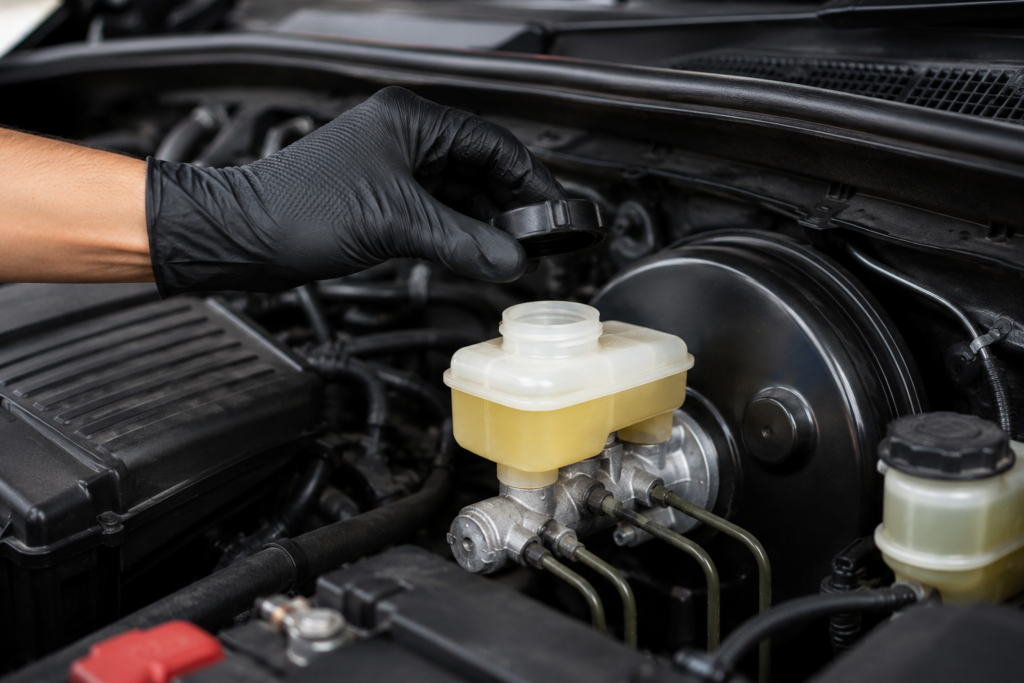
The reason is its hygroscopic nature. DOT 4 and DOT 5.1 brake fluids absorb moisture from the air through the reservoir vent, rubber hoses, and seals. This process occurs continuously, gradually increasing the water content inside the brake system. It is important not to confuse DOT 5.1 with DOT 5. DOT 5.1 is glycol-based and fully compatible with DOT 4, while DOT 5 is silicone-based and designed for different braking systems.
How Moisture Changes Brake Performance
Fresh brake fluid has a high dry boiling point. As it absorbs moisture, the boiling point decreases, resulting in what is known as the wet boiling point. During long downhill descents, heavy city traffic, or repeated hard braking, the temperature of the brake calipers and wheel cylinders rises significantly. If the brake fluid already contains excessive moisture, the water begins to boil, creating vapor bubbles inside the hydraulic system.
Unlike liquid, vapor is compressible. As a result, the brake pedal becomes soft, and braking performance decreases noticeably.
The following symptoms may indicate this problem:
- increased brake pedal travel;
- a soft or spongy brake pedal after heavy braking;
- inconsistent braking response;
- darkened brake fluid.
These are the primary consequences of brake fluid hygroscopicity. At the same time, the braking system may remain completely sealed, with no visible fluid leaks.
Why the ABS Module and Brake Cylinders Are Affected
Water inside the brake system is dangerous not only because it lowers the boiling point. It also promotes condensation inside the hydraulic lines, gradually initiating corrosion. The brake cylinder pistons, hydraulic control module valves, and ABS passages are particularly vulnerable. Metal particles produced by corrosion circulate throughout the hydraulic system, accelerating wear of expensive components. Once contamination reaches this stage, even properly bleeding the brake system may not completely eliminate its effects.
How to Check the Condition of Brake Fluid
The color of the brake fluid alone is not a reliable indicator. Even relatively clean-looking fluid may contain a critical amount of moisture. For this reason, technicians use a dedicated brake fluid tester that measures moisture content within just a few minutes. This brake fluid moisture test provides an accurate assessment of the hydraulic system and helps determine whether replacement is necessary.
During brake system service, technicians also inspect:
- hydraulic line integrity;
- the condition of the reservoir and seals;
- brake bleeder screws;
- any signs of condensation or internal corrosion.
Why Preventive Replacement Costs Less Than Repairs
If the brake pedal suddenly begins sinking toward the floor, there may be several possible causes, one of which is boiling brake fluid with excessive moisture content under heavy braking conditions. It is far better to prevent this situation than to deal with its consequences. Routine brake fluid replacement is significantly less expensive than rebuilding brake cylinders or repairing the ABS hydraulic control module.
Many drivers also ask what determines the cost of brake fluid replacement in Kyiv. The service includes not only the new brake fluid itself but also proper bleeding of the hydraulic system, complete removal of the old fluid, and verification of brake system performance after maintenance. Replacing brake fluid according to the recommended time interval helps maintain consistent braking performance, prevents internal corrosion, and preserves maximum braking efficiency regardless of the vehicle’s mileage.
Top popular news
- There is a smell of gasoline under the hood, but there are no signs of a leak: where to look for the problem
- Volkswagen Golf 7: which engines are considered the most successful in the secondary market
- Why do errors appear after a night frost that disappear after warming up?
- The car stalls when you suddenly release the gas: what happens at this moment
- Audi A6 with 200+ thousand mileage: what expensive malfunctions can be predicted in advance
- Why does my car start to consume more oil even though my driving style hasn’t changed?
- The ABS light came on on the dashboard: can I continue driving?
- Volkswagen Passat B8 or Skoda Superb: what will the car show after 200 thousand km

Subscribe to our newsletter!
To stay updated with the latest news

Book a service